

Why Warrington’s Infrastructure Makes It a Strategic Property Investment Location
The strongest investment locations are rarely sustained by hype. They are sustained by employment, movement and the infrastructure that connects people to opportunity.
When people first start looking at property, the conversation usually goes straight to numbers. What is the yield? What is the entry price? How quickly can you refinance?
Those questions matter, but in my experience they are not what separates a superficially attractive deal from a sustainable investment.
The investors I see perform well over time tend to examine something deeper: what is genuinely driving demand in the area? They look at employment, connectivity and how a location fits into the wider economy.
That is where Warrington stands out. It is not a market defined by dramatic headlines. But when you step back and consider how the town is positioned, it becomes clear why its fundamentals deserve attention.
Positioned Between Major Economic Centres
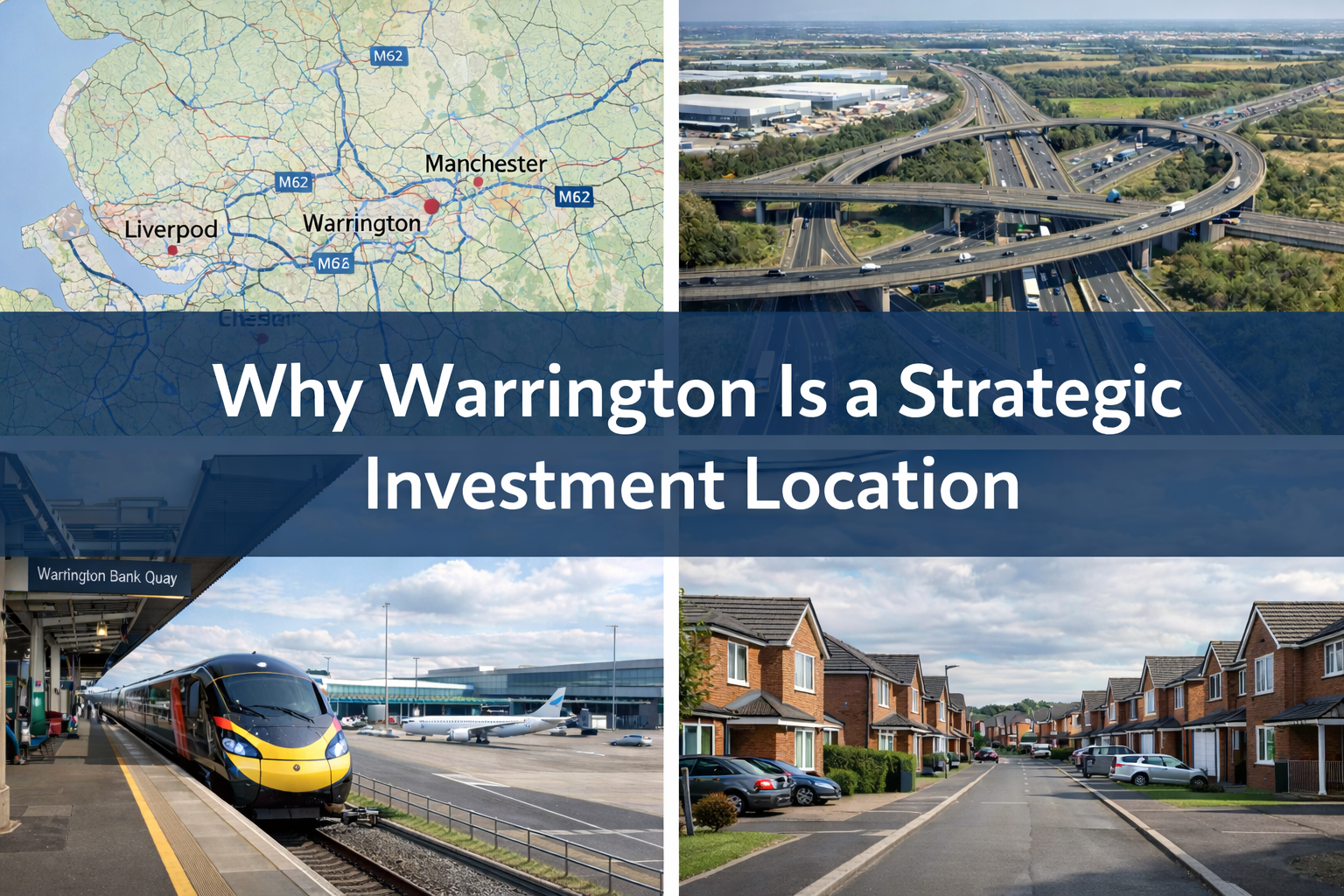
One of the things that first drew me to Warrington was its location. It sits between Manchester and Liverpool, with Chester also within practical reach. That may sound obvious, but the investment significance of this position is often underestimated.
Instead of relying on the strength of one city, Warrington benefits from several. People working within Manchester’s financial and technology sectors, Liverpool’s commercial economy or Chester’s business community can realistically live in Warrington and commute.
That produces a broader potential tenant base than is available in a more isolated location. From an investment perspective, this matters because demand is not dependent upon one employer, one industry or one narrow economic centre.
Warrington is not relying on one city for its momentum. It benefits from movement across an entire regional economy.
Why the Motorway Network Matters
Warrington sits at the intersection of the M6, M62 and M56. This is more than a matter of convenience; it is one of the reasons the town has developed into an important logistics and distribution centre.
Businesses that rely on moving goods across the UK need to operate from well-connected locations. Over time, major warehousing, supply-chain operations and industrial sites have become established around these transport routes.
Where those businesses go, employment follows. And where employment grows, people require places to live. Infrastructure therefore supports property demand indirectly, by enabling the wider economy around it.

Changing Work Patterns Strengthen the Commuter Case
Road access explains much of Warrington’s commercial appeal, but rail connectivity also plays an important role in residential demand.
Warrington has direct links to Manchester, Liverpool and London. This gives residents access to a wider range of employers and opens the town to people who do not need to live directly within a city centre.
Working patterns have become more flexible. Many people no longer need to commute every day, so they can choose a location that offers more space or value while retaining access to a major city when necessary.
Warrington fits that pattern well: strong access without the same city-centre premium. That balance is a meaningful part of its appeal.

Connectivity Extends Beyond the Region
Another factor that receives less attention is airport access. Manchester Airport is within easy reach and Liverpool John Lennon Airport is also nearby.
For businesses, this makes national and international travel easier. For investors—particularly those based overseas—it makes the location feel accessible and clearly connected to a wider economic network.
Access to three nationally important motorway corridors.
Direct routes into regional cities and onward to London.
Practical access to both Manchester and Liverpool airports.
Employment Growth and the Logistics Effect
Infrastructure does not create property demand in isolation. Its value lies in what it enables.
In Warrington’s case, transport infrastructure has supported substantial employment activity, particularly within logistics. This includes not only warehouse roles, but managers, engineers, planners and support staff. A wider service economy then develops around these businesses.
The result is a layered employment base. This supports demand from different kinds of residents rather than one narrow group, and it can provide greater resilience if one part of the economy slows down.
There were more than 35,000 logistics-related jobs across the Cheshire and Warrington area as of 2021. From an investment perspective, that employment base helps support continuing housing demand.
What the Market Data Shows
The figures sit in a range that reflects a functioning, comparatively balanced market rather than a location dependent upon extreme pricing or unusually high rents.
You are not necessarily seeing values driven purely by hype, and an investment case should not depend upon optimistic assumptions. The underlying attraction is the relationship between access, employment and sustained demand.
These are dated figures retained from the original article and should be checked against the latest Rightmove and Office for National Statistics data before publication or investment use.
Translating Infrastructure Into Investment Terms
When the different factors are considered together, the investment logic becomes clearer. Demand is supported by genuine employment rather than speculation. The potential tenant base is broad rather than concentrated. And the location is connected rather than isolated.
That combination can produce more stable outcomes. It does not remove risk—no property market is without risk—but it means an investor is working with identifiable fundamentals rather than relying entirely upon short-term price movement.
- Employment distributed across several sectors and nearby cities
- Multiple road, rail and air connections supporting mobility
- Residential demand supported by both local and commuter employment
- A market case based on structural fundamentals rather than headlines
Who Warrington Tends to Suit
Warrington will not suit every strategy. Investors pursuing exceptionally high yields in more volatile areas may look elsewhere, as may those relying upon rapid short-term price movement.
In my experience, it is more naturally aligned with investors who think in longer timeframes and value steady demand, reasonable entry points and a market that makes sense structurally rather than emotionally.
Those prioritising durable demand over short-lived market excitement.
UK and overseas buyers who value an accessible, well-connected location.
Investors who begin with employment, infrastructure and tenant demand.

A Market Built on Position, Not Noise
Warrington is not a headline-driven market. Its case rests on how the town is positioned and what surrounds it.
Infrastructure, employment and connectivity work together in a way that can support long-term demand. That is what I focus on when assessing opportunities in the area: not simply what a property promises today, but what continues to make the location useful tomorrow.