
How Why Warrington's Infrastructure Makes it a Strategic Property Investment Location
When people first start looking at property, the conversation usually goes straight to numbers.
What’s the yield? What’s the entry price? How quickly can you refinance?
Those things matter, but in my experience, they’re not what separates a good investment from a sustainable one.
The investors I see do well over time tend to look at something slightly different. They focus on what’s actually driving demand in an area. They look at employment, connectivity and how a location fits into the wider economy.
That’s where Warrington stands out.
It’s not a market that gets a lot of attention, and it’s not driven by headlines. But when you step back and look at how it’s positioned, it becomes clear why it works.
There’s no rental income to offset delays.
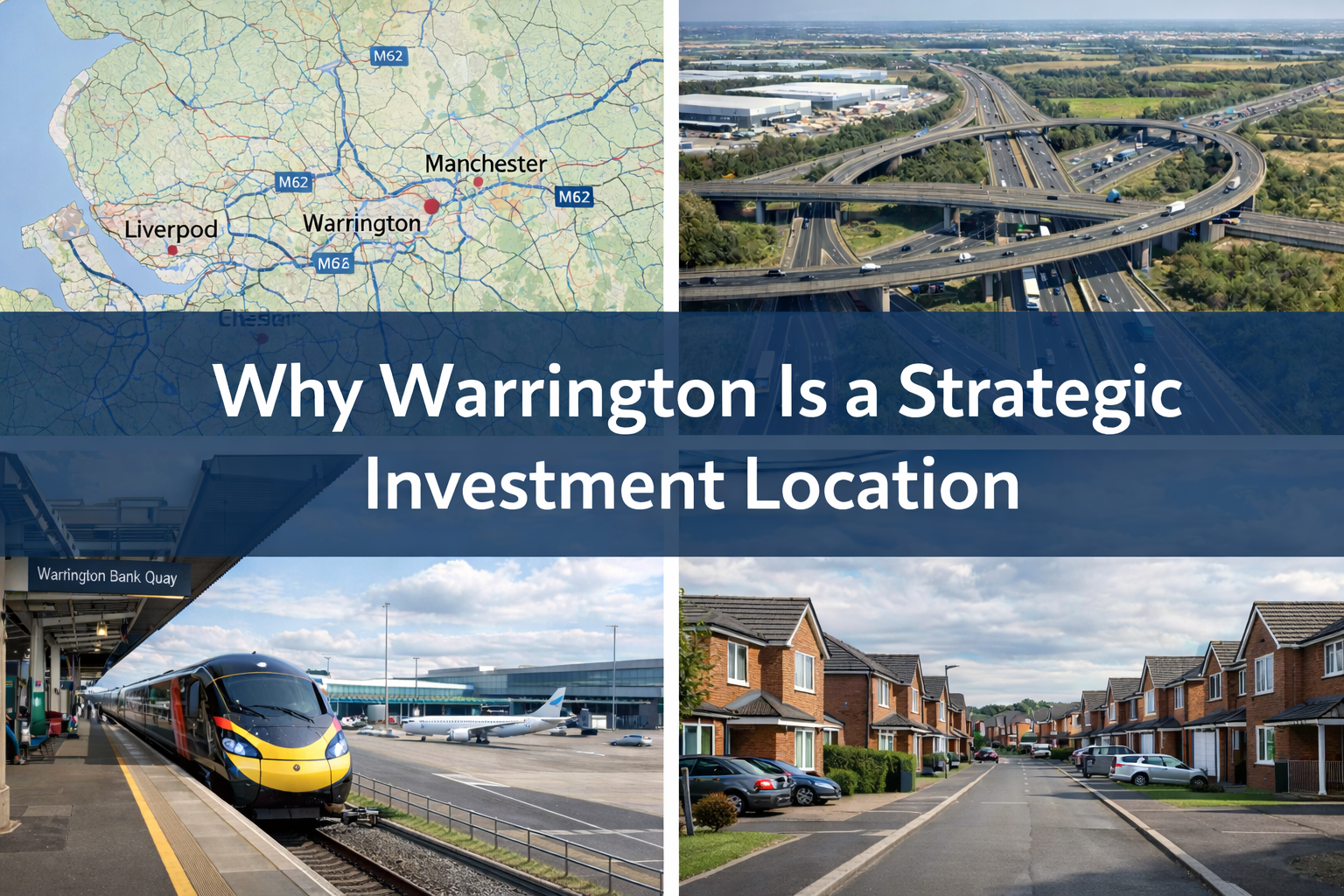
Positioned Between Major Economic Centres
One of the things that first drew me to Warrington was its location.
It sits between Manchester and Liverpool, with Chester not far away either. That might sound obvious, but the impact of that positioning is often underestimated.
Instead of relying on one city, Warrington benefits from several.
People working in Manchester’s financial and tech sectors, Liverpool’s commercial industries or even Chester’s business environment can all realistically live in Warrington and commute. That creates a much broader tenant base than you get in more isolated locations.
From an investment perspective, that matters.
You’re not relying on one employer or one industry. You’re tapping into movement across a wider region, which tends to be more stable over time.

Why the Motorway Network Matters
Warrington sits right on top of the M6, M62 and M56.
That’s not just convenient, it’s one of the reasons the town has developed the way it has.
Businesses that rely on moving goods around the UK need to be in places like this. Over time, that’s turned Warrington into a logistics and distribution hub.
You’ve got major warehousing, supply chain operations and industrial sites all centred around these transport routes.
Where those businesses go, jobs follow.
And where jobs are created, people need somewhere to live.
Rail Connectivity and Changing Work Patterns
Road access explains the commercial side, but rail connectivity plays a big role in residential demand.
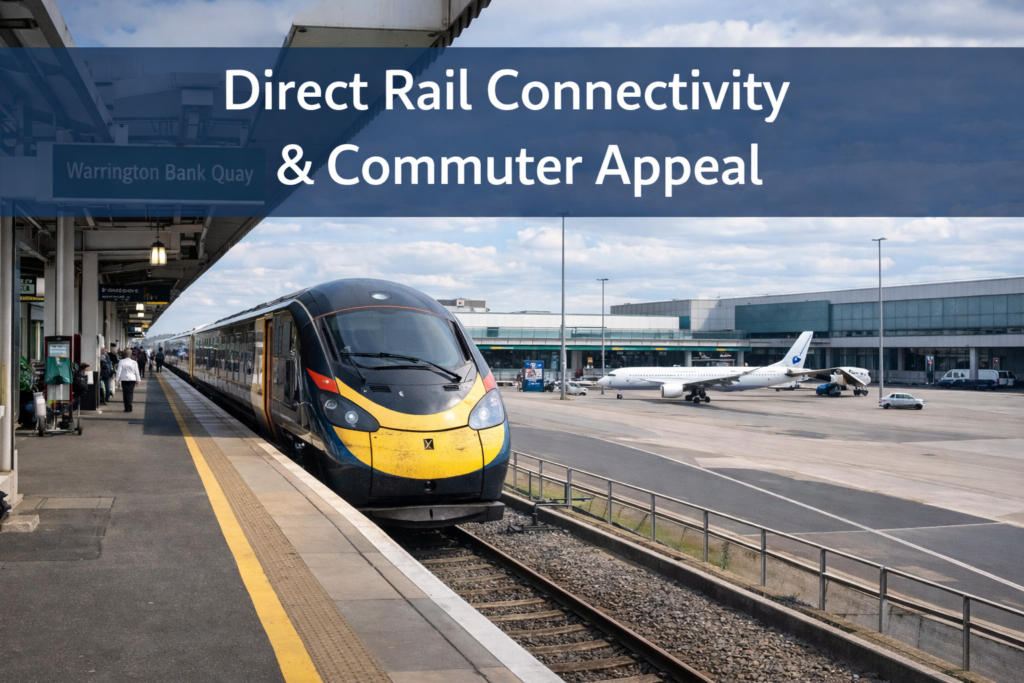
Warrington has direct links into Manchester, Liverpool and London. That opens it up to a different type of tenant.
What I’ve noticed over the last few years is that people are more flexible about where they live. They don’t necessarily need to be in the city every day.
So instead of paying city-centre prices, they look for somewhere that gives them access when they need it.
Warrington fits that well. You can reach major cities easily, but you’re not paying the same premiums.
That balance is a big part of the appeal.
International Connectivity and Accessibility
Another factor that doesn’t get talked about much is airport access.
Manchester Airport is within easy reach, and Liverpool Airport is close as well.
That matters more than people think.
For businesses, it makes travel easier. For investors, especially those based overseas, it makes a location feel more accessible and connected.
If you’re investing from abroad, you’re naturally more comfortable with places that are easy to reach and clearly part of a wider economic network.
Employment Growth and the Logistics Effect
Infrastructure on its own doesn’t create demand. It’s what it enables that matters.
In Warrington’s case, it’s enabled a lot of employment growth, particularly in logistics.
That includes not just warehouse roles, but managers, engineers, planners and support staff. Around that, you get other services building up as well.
What you end up with is a layered employment base.
That’s important because it supports demand across different types of tenants, not just one group. It also tends to hold up better if one part of the economy slows down.
There were over 35,000 logistics-related jobs in the Cheshire and Warrington area as of 2021, and demand in that sector has remained strong since .
From an investment point of view, that kind of employment base supports consistent rental demand.
What the Market Data Shows
If you look at the numbers, it backs this up.
According to Rightmove, the average property price in Warrington over the past year is around £296,286 .
Rental data from the ONS shows average monthly rents at roughly £873 as of January 2026 .
Those figures aren’t extreme in either direction. They sit in a range that reflects a working, functioning market.
You’re not seeing inflated pricing driven by hype, and you’re not relying on unusually high rents to make deals work.
It’s more balanced than that.
Translating This Into Investment Terms
When you put all of this together, a few things become clear.
Demand is supported by real employment, not speculation. The tenant base is broad, not concentrated. And the location is connected, not isolated.
That combination tends to produce more stable outcomes.
It doesn’t mean there’s no risk, because there always is. But it does mean you’re working with underlying fundamentals rather than hoping for short-term movement.
Who Warrington Tends to Suit
Warrington isn’t for everyone.
If someone is chasing very high yields in more volatile areas, they’ll probably look elsewhere. The same goes for people trying to flip quickly based on short-term price movement.
In my experience, it tends to suit investors who are thinking longer term.
People who want steady demand, reasonable entry points and a market that makes sense structurally rather than emotionally.

Conclusion
Warrington isn’t a headline-driven market.
It’s a place that works because of how it’s positioned and what sits around it.
Infrastructure, employment and connectivity all come together in a way that supports long-term demand.
That’s what I focus on when I’m looking at opportunities in the area.
If you’re considering the North-West and want to understand what’s currently available or how different opportunities stack up, I’m always open to a conversation.